Showing posts with label Education. Show all posts

Thursday, July 31, 2014

Mundane Mondays

Recently my posts focused on the several community projects my counterparts and I are engaged in. However, my day to day can be generally just as uneventful as yours and I wanted to share that with you in an extremely unnecessary and analytical way.

In the Peace Corps, I have become more diurnal than my previous university self. I can barely stay up after sunset, and I wake up just 30 minutes post-sunrise. Summertime I usually wake up around 5, and now that it is Winter I wake up around 7. It’s still pretty cold nowadays, so when I wake up I stay huddled in my blanket trying to absorb some of the leftover warmth of my rubber water bottle heater. Technically, teachers are required to be at school at 7am to observe the morning study. However students are always late, and teachers are even later. It supposedly happens every year. When the school year starts, teachers and students are gung-ho and we are always present before 7. As the school year proceeds, we show up progressively ten minutes later than the previous month until we reach the 2nd semester, where we show up at 8am. During my training, we were encouraged to integrate by modeling behavior, therefore this is subjectively one of those opportune moments to gain an optimal standard of integration. I’m not lazy, I just want to retain the heat I generated in my cocooned blanket throughout the night.

7:45am. I am late. I jump out of bed, brush my teeth outside, toss my pee bucket remains into my “flourishing” garden, greet my neighbor child pooping in the trash heap ahead of me with a gentle wave, slip into some warmer clothes for school, drag my two solar setups outside and rush out the door. As I walk towards the school I realize I left my red pen back home, run back, realize I should probably urinate and run back out to my latrine for a quick release.

Basotho roulette to see who greets me in the morning

I get to school by 8:00am. We are late to start our morning assembly, but I somehow always arrive right before the students sing the National Anthem. In the United States we raise our right hand and place it over our heart to recite the pledge of Allegiance. In Lesotho we sing (sometimes passionately, we are a big singing people) the National Anthem and keep our arms and hands at our sides parallel to our bodies. After, we sing a church hymn. We have 5 grades in the school, so Form A leads the songs on Monday, and Form E closes with usually a stellar performance on Fridays. The Form A’s for some reason just don’t get it. We have done it everyday since the beginning of the year, but they always, as a collective group of 150 students, somehow forget that they should sing. Heathens. After some announcements, the teachers release the students to the classrooms except for the Form A’s. Because they didn’t sing on time, and probably sang pseudo-synergistically, becomes pertinent to have a massive corporal punishment session. 

The morning assembly line-up

8:20am. The form A’s line up to receive their weekly character building energizer. Honestly, corporal punishment isn’t that bad at my school. My staff has even talked about how we shouldn’t do it as much, but it’s just an easy solution for the teachers - students actually say if you don’t beat them, they won’t learn. Parents even want teachers to beat the children. I don’t beat any students however, I do punish by ensuing creative psychological embarrassment torture methods. What I dislike most about this method of punishment is that it causes a lot of noise, which is distracting when I am teaching a different class. Also, I expect the teacher who is beating the students to be very tired, that’s over a hundred swings. Students are smart however. They always seem to move their hand at the right time away from the stick in order to lessen the blow.

The students are choosing who gets beaten first

9:20am. I get to my favorite class. These students know how to distract me, but I don’t even mind. They always get me to talk about sex, and since we don’t have Life Skills I consider these lessons important. I always talk about HIV/AIDS, its history, prevention, and treatment. However recently we started talking about other sexually transmitted diseases. I usually get my phone and browse the Internet for various disturbing photos and pass it around as a teaching aid. Recently a student somberly sauntered up to me and said, “Tonight I will have nightmares.” I was proud, but I think I did my job when another told me he would never have sex. I don’t tell them sex is bad, I just describe that it can be dangerous if you are too scared to pose questions, don’t protect yourself and or know the risks. A result of encourage inquisitive minds led to a complete backfire.

“Sir is sex nice?” “How do girls masturbate?” “Do you do the oral sex?” I thought I was supposed to make them feel uncomfortable. I am not sure if it is right, but I try my best to answer accurately yet appropriately. Keep in mind that many of us learned from Google because we were too encumbered to ask our towering adult figures. They don’t have the luxury of the Internet and the parents are even less knowledgeable of the issues. I like to think I am a walking, talking, sextionary (sourcing my iPhone).

I also had to teach about crabs

10:40am. I get a break, run back home and eat some leftover dinner for an early lunch. Sometimes I buy makoenya and polony, which are essentially fried dough bread balls and bologna. It is not bad, but not that great either. Then I get back to school to finish the rest of my classes.
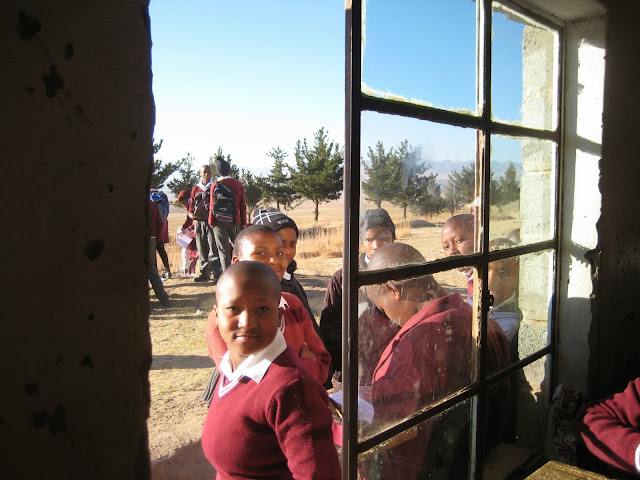
Students relaxing on break absorbing sun to stay warm

At 1:00pm we break for lunch. All of last year I used to eat the school food. I now choose to eat at home. I enjoy Basotho food, but not school food. Often you encounter foreigners in African countries chastising the quality of the food the African children or people eat and advertise it as an injustice. Although I don’t eat the school food, the kids love it. Just because it isn’t American style food doesn’t mean the whole continent is starving. Papa (boiled corn meal, almost like plain grits) and Meroho (spinach or cabbage) are what the students usually get. Tuesdays and Wednesdays they get protein through beans, eggs, or hot dogs (we call them Russians). Around this time, we as the teaching staff can just relax and chat. Usually it is all in Sesotho but it turns into English whenever I want to chime in.

This is papa (white)

We have fun conversations on all sorts of topics. My favorite conversations however are when we talk about the differences in our accents, or when they teach me inappropriate Sesotho lingo.

When classes end, the afternoon study begins around 2:00pm. Some teachers and I will work on secondary projects, which included the HIV/AIDS Soccer Tournament, the Solar Paneling, and now the Library. The library is coming together really well, but slowly; I will create another post on its completion.

The girls helping with the library

I get home around 4:00pm at which time my Mother never ceases to send a whatsapp encrypted, “Good Morning Shawnee.” Now, I have never brought this up with her, but I hope she realizes I am at least 6 hours ahead. So when she says good morning, does that mean she is telling me she is having a good morning? Or is she telling me that tomorrow when I wake up to have a good morning? She calls every few days and we chat for an hour while I pace around my house. I can’t bring my phone inside or else I lose reception. During the call, she always laughs at the random chicken or cow noises in the back, the numerous children squabbling, and my interrupted greetings to fellow villagers (it is very rude to not say hello here).

These boys are always playing knock-knock ditch 

At 5:00pm students sometimes show up for some extra studying or just to talk. I don’t mind because it is often the older students who are around my age. While they are hanging out on my couch I indulge them with random American foods or anecdotes and prepare dinner. I try to cook early while I have daylight because cooking and eating by candlelight may be romantic for two, but it is intolerably ill advised for one. They leave just before dark and I start eating my dinner while warming up water for my bed. I snuggle into the covers around 7:30pm, watch some random movie or tv show on my laptop while whatsapping friends in the States and here. I quickly fall asleep around 9:00pm if I am able to make it that late.

The family I usually say goodnight to

I am lulled to sleep by the gentle random unpredictable church hymns surrounding the school compound getting ready for another day.

I hope you enjoyed getting an exclusive peek into the wonderful world of a rural Peace Corps Volunteer. In related news, I have been nominated as a finalist for the Blog it Home Competition for the Peace Corps. The Peace Corps has three goals which paraphrased are: 1) Do Development Work for your Host Country. 2) Provide Insight into American Culture to Locals. and 3) Make Americans aware of your Host Country and what it is like to be a Peace Corps Volunteer.

This Peace Corps Competition is centered on the 3rd goal, and with your help I may be able to attend a conference in Washington D.C. to represent my host country of Lesotho (The Forgotten Kingdom). As an avid Math/Science enthusiast, I rarely considered anything English-Oriented of mine to be generally literate, but it has been very encouraging to hear all your comments about my blog, my work, and especially being recognized as a finalist. Between August 1st and 10th you will get an opportunity to like a certain picture that is linked to my blog on the national Peace Corps Facebook Page. The more likes/comments I get, the more likely I can become one of the chosen ones in September. 

Like the photo by clicking this link:

https://m.facebook.com/peacecorps/photos/a.10152404780060914.1073741843.110634980913/10152404780180914/?type=1&source=43


If all goes well, maybe I'll see some of y'all in D.C. 


Sunday, July 6, 2014

Tuition Assistance Program

Last year I became a co-chair of the Tuition Assistance Program. This committee, under Peace Corps Lesotho, works with the home based organization of Friends of Lesotho. Friends of Lesotho is comprised of several people stateside, Returned Peace Corps Volunteers or those who have worked in Lesotho in the past, who still remain vital, active members in the development of Lesotho. This post is to explain TAP and FOL’s purpose in aiding to the education sector of development in Lesotho.

Our senior team

Education in Lesotho has been one of the major fronts of development that the Peace Corps community has been addressing. Unlike the states, the government of Lesotho provides only some of the schooling for students. Children get no monetary support from the government for pre-school or kindergarten (actually I believe in the states, pre-school is also not provided for). The government does start funding children at Standard 1, or 1st Grade. They are paid for in full (with food for lunch) from Standard 1 until Standard 7. However funding for students cease upon graduation of Standard 7.

Although most schools have no electricity, no running water, little to no visual aids, and are essentially concrete cubes, the students perform vibrantly. They are taught English starting in Standard 5 and gain some form of fluency by the time they enter High School. The government unfortunately does not pay for students starting at Form A (8th Grade). This means that parents or guardians must save money for their students if they want them to enter high school. At my school the high school fees are R 1350 or approximately $130 USD for the entire year. This however does not include book fees or exam fees, which are similarly comparable.

Working hard

This may not sound like much for parents or guardians to handle, but in a country where 75% of the population is unemployed and most rural villagers get food from subsistence farming rather than through economic means, mustering the R 1350 to send just one of their many children into “higher” education can take its toll on the family. For those students who are double orphans (both parents deceased) the government does pay for the students in full as long as birth and death certificates can be materialized. Therefore the most at risk students who have the most difficulty paying are those who are single orphans, and whose living guardian isn’t working.

That is where TAP, or the Tuition Assistance Program, comes in with its support from Friends of Lesotho. The main premise as to further the education of the citizens in developing countries is that those who become educated will then in turn bring about further development in their own country. Education is the tool that trains a system to be self-serving. The true purpose to volunteering and development is to have that country become self-reliant. TAP and FOL hope to achieve that by funding the brightest, yet neediest of the students in the many schools in Lesotho.


Our most important meeting

The Peace Corps Volunteers in Lesotho work directly in the schools and gain insight and develop personal relationships within the school. We learn to see which students try the hardest, which ones are excelling with little to no parental support, which ones just need a little more help to become the tools for the future. Each volunteer who wishes to have their school participate in TAP scholarships submits up to 5 students chosen by the volunteer and the volunteer’s community. These students must not be a school member’s child (meaning a school member has a well paid job in order to pay for their child), must not have any other scholarship (for example: government double orphan scholarship known as manpower), and must be in the top third of the class (to statistically assess which student scholarships may allow more students to enter tertiary schooling).

These students then write compositions, which are used to judge their English skills and used to thank the sponsors that provide FOL with funding. The process is a simple one, with plenty of people benefiting.

Some students who applied 

Last year 30 schools participated with 290 students given half scholarship. Friends of Lesotho donated over $17,000 USD. This year 37 high schools in Lesotho applied. 71 students were awarded full scholarship while 46 students were awarded half. Approximately $10,600 USD was awarded and distributed giving the 117 students incentive to stay in school longer. The amount of funding is directly related to how much support is generated to FOL from America and other organizations. These students often receive food, life skills education (HIV/AIDS prevention), and invaluable mentorship. These students are encouraged to continue working hard to keep up their marks and we predict great things to amount from them.

Let's keep these kids in school

Without TAP and the support from FOL, these students may have been dismissed from their education. If you are interested in supporting FOL in its TAP endeavors next year please check out their website:

http://www.friendsoflesotho.org


Tuesday, May 7, 2013

School School School

Although I have not posted in awhile, I plan on catching up very quickly. School started January 28th, and it has been a nonstop ride. Although this may come off chauvinistic and conceited, I would say my science and math skills are sufficiently adept, and I rarely have to look at a book to know I am on the right track while teaching. But teaching, especially to students where English is a second language, is extraordinarily difficult and frustrating.
The culture here is much more relaxed, where deadlines for homework can be flexible, students who are late to school, still leisure their way over. For the first three months of teaching, I always compared my high school time to the Basotho version of High School. I questioned why students don’t care about coming late, or why they don’t care about studying or turning in homework, and even why come to class if they aren’t going to take notes or pay attention. My philosophy is that if you don’t take notes, or don’t pay attention, than you probably already are starting at an A in my class. But the students don’t strive for American A’s; they strive for passing, which is a dismal 50. And if they don’t pass, they laugh it off as if nothing is really the matter.
But then I took a step back, and tried to come up with reasons why they don’t consider school as important as I did growing up. Many of these students are single and double orphans, meaning that they have no parental figure guiding them, or explaining them why education is important. Even so, it is easier here for men, and even women, to get a job in the mines without a formal education, and still make a lot of money. At Fobane, we see a lot of villagers returning at the month’s end, and they are doing just fine economically. Basotho here generally don’t buy much, and the food they grow is enough for them to survive and eat fine. Many students also have not ventured out of the village often, or have only seen the local close by camp towns such as Maputsoe or Teyateyaneng. Therefore, there is no real motivation for them to see that education can really help them. Why change something that you are already content with? And its true, Basotho all over the village are extremely happy, kind, and generous people.
My primary job here is to educate the high school students in math and science, and also to motivate them to understand how proper education can open up their world. I started a few things in my school, one being a prefect system, based on Harry Potter, which creates an environment for students to speak English more often. There are two students in each class, boy and girl, who teachers have chosen as the prefects and their job is to write down the names of students who speak Sesotho. In theory, this will prepare students for their final COSC exam in their Form E (Kind of like the SAT), which is entirely in English. This idea has definitely gotten more people to speak English, but has also created a lot of work for the English Teachers and myself. When a student gets caught speaking Sesotho, their punishment is to write an Essay in English on one of the fun topics we came up with. It is still a work in progress idea, but I hope that diligence will eventually make a permanent English-speaking environment at School.
The other big thing I started here was a general peer-tutoring club, where I bring Form B students (9th grade) to the primary school to teach Standard 7 students (7th grade) math. This was a great endeavor, and students really enjoyed it. Although I am unsure of the impact, it definitely exposes my Form B students to older material that they both forgot, and need for the future. This tutoring then spread between classes in my high school, so students in Form C tutor Form A students, and Form D students tutor form B students. Unfortunately this past month after my vacation to Port Elizabeth (next blog post), this club died down because every day after school the time I had for tutoring was used for practicing cultural dances for Cultural day (also next blog post).
I also joined the Teacher's soccer team, and I'm surprisingly not as bad as I expected. But these teachers, even the large round ones, can run and play soccer a lot longer than I can!
I hope this was an easy to follow post, updating you on my main job in school!