Showing posts with label HIV/AIDS. Show all posts

Sunday, August 31, 2014

Seeing Happy Endings (Phrasing)

As my Close of Service (COS) approaches, I can’t help but be more introspective and reflective. The Peace Corps is a two-year program and while many people may think that is too long, it honestly isn’t long enough. Most of us are now seeing the fruits of our labor in largely unexpected ways, and even seeing our projects showing strong signs of sustainability and progress.

One success is that now about once every two weeks the teachers and I eat meat together!

SEX BOOK

Along with my main goal of improving math and science education, I am entrusted to impact my community on the HIV/AIDS front. Although my school does not have a life skills time slot during our schedule, I find about five minutes every class to inform my students on various topics usually related to sex. Just the other day we had the head nurse from our Millennium Clinic visit our school and give “The Talk” and during the entire course of our awkward question and answer period, the students kept mentioning how I love to talk Life Skills. 


This kid

Additionally, our library shelves have been finished and it is more or less organized and running. One day on my way back home from school I overheard a few students speaking in English and talking about Sex. I snooped a bit further and looked over their shoulders while acting like I was just on my phone. They were holding a book titled “Sex” found in our Life Skills section of our library. At that moment, I realized how three initiatives my teachers and I started actually proved in someway successful.


1) Our Library is self-sustaining. Students know that if they want science, life skills, or any books the library is available to that at all times.


2) These students were practicing English without being forced to. Last year I tried so hard to make my students speak English and met so much resistance. This year I essentially gave up, but you can still hear whispers between students encouraging each other to continue speaking English.


3) My students were no longer scared to talk about Sex freely. They weren’t inhibited or embarrassed if other teachers saw them with the book, and they were taking the books home. This means the shyness and ignorance about sex and sexually transmitted diseases is being chipped away, literally (Archer figuratively)at the grassroots level.


Before these two years started, I knew what our jobs entailed, but I had no forethought that these projects could synergistically mingle in such positive ways, and I was simply lucky enough to witness just the beginning of what seems to be pure development and progress.


Also in these two years I would have no idea that my roof would finally get fixed!

Life Skills Play

Because I am a native English speaker, I have almost automatically and willingly been adopted into our English Department. I am often asked for advice, or for help with our school debates and compositions from students or teachers. 

Debate

I often feel like a walking dictionary (Beyond ironic if you know who I am). One day our English Club approached me for assistance on their Drama that would occur on our English Day Festival. I am no Shakespeare either, and therefore I simply posed the question, “What do you want it to be?” Instantaneously they said they wanted to create a Life Skills Play and I stood their quivering with excitement (Archer Phrasing). More often than not students don’t care for life skills, and definitely don’t want to advertise any sex-talk to the entire school (especially to the audience of teachers). So I posed the next question, “What if you had HIV/AIDS, what would be the first thing you do?” I proposed the topic of the drama, and then I let them come up with each step after. It was a short play, but it was an interesting way to understand their thoughts on the idea of HIV/AIDS on a more personal level. The play went as the following:


A female student has two boyfriends. One is good and one is bad. She tests at the clinic and finds out she is positive. The ausi (girl) becomes insanely depressed and confused while the nurse is telling her all will be well with medicine and counseling. The ausi ignores and seeks after her two boyfriends. She meets the bad boyfriend first who gets angry, and tells her that he can’t have HIV/AIDS because he is circumcised from the mountains, uses more than one condom, has ten sex partners who are also negative, etc. She tells him to get tested and meets the good boyfriend who is shocked, supportive, but hesitant to get close to her. She then tells her best friend who reacts the same way. The boyfriends end up drinking at the local bar and gossip to the whole school that this ausi is HIV positive, and the next day at school she is embarrassed because people are too scared to share food with her, or even sit near her. She runs home and abandons school. She then paces outside depressed and angry, and ultimately exclaims verbally her intention of suicide. The mother overhears her and calms her child. They go back to the clinic seeking counsel and medicine. The Ausi is a bit chipper and less ashamed. She then boldly goes in front of the whole school and preaches to them about her HIV positive status and encourages others to test. Everyone is then impressed and thrilled for her positive attitude and her confidence. The good boyfriend comes back and says he still loves her.

Fin


 My drama folk

A pretty complex, and insightful drama essentially thought of and acted out by students who have had a lifetime of impedances to their life skills education. I felt extremely proud that they had the courage and tenacity to formulate and execute such a mature play.


Soon I will be updating on our Solar for Breakfast project and perhaps some intriguing weird fun times. Updating certain news: I did not win the blog competition, but I was fortunate and happy enough to become selected as a finalist. It did boost my blog’s readership and that was what I needed most to ensure my inceptive thoughts to roam free in the minds of a multitude of Americans. I will be leaving Lesotho Oct 10th, and will see many of you shortly. The political unrest that is currently ongoing is nothing to be startled by, and it may calm you to know I am not by any means close to the capital.

A week before the political unrest, I was on vacation eating in the capital with my cousin. 

Wednesday, July 23, 2014

Solar for Breakfast

In January, my principal and I came together to tackle some of the issues that plagued our high school. The following are what we came to agree were the most devastating yet solvable issues:

Our school office

  1. Hunger. Our double orphans come to school hungry. Because they are in school, they neither have the time nor resources to grow their own food. They also don’t have any income in order to purchase food. Therefore, when they do attend school (tuition provided by the government), they are sluggish, inattentive, and unable to perform to dig themselves out of poverty. It is impossible for these students to learn effectively when malnourished.

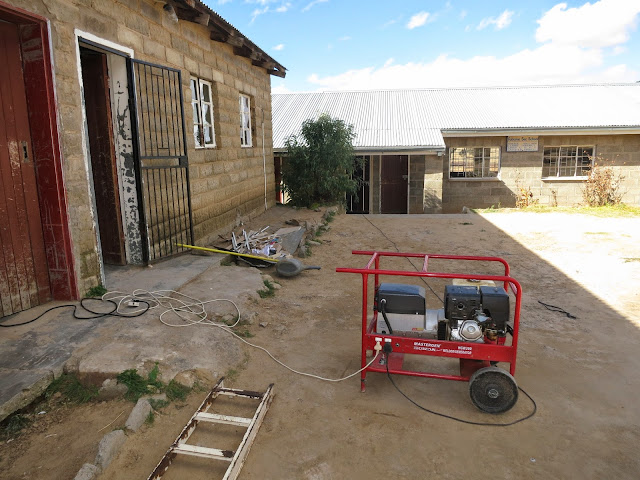
  2. Electricity. Our school is spending excessive amounts of money on petrol for our generator to provide students with scholarly material, quizzes, and exams. The generator provides unregulated current that damages our computer and printers at least once a semester resulting in costly repairs and maintenance. We use the generator to run our school television during fundraisers, but unfortunately with the rising cost of petrol, our profits have been plummeting leading to a continued cancelling of our HIV/AIDS related secondary activities.


  3. HIV/AIDS. Fobane High School does not have Life Skills education, which leaves our children more vulnerable to HIV/AIDS and an unprepared adulthood. Our English Club wants to desperately create a Life Skills/English Magazine in order to provide some education on this front. Previous magazines incorporated several important life lessons through grabbing images, and stories, however it had to be sold at such a high cost to the students that only ten were able to afford it. The inability to distribute the information leaves us just as precariously threatened to HIV/AIDS as before.

    A free condom distributor now in every shop!

To address the issues we cleverly evoked one material solution that would perpetuate the solving of the others. The idea was to create a sustainable solar panel system that would save money on petrol. Half of the expected savings would then create a breakfast fund to provide nutrition to at least half of the double orphan population. The other half of the savings would be used as emergency maintenance and repairs in the event that the green energy system would falter. Without the need to purchase petrol, the Life Skills Magazine would then be affordable for individual purchase and HIV/AIDS education can be distributed among the masses for invaluable CAPACITOR building.

Me caring for my own solar

We applied for a grant through the Peace Corps to generate the funds and purchase a large solar panel system. The project cost roughly $3000 USD and the grant covered about 75%. The system consists of 6 85W panels resulting in 510W of clean electricity stored in 6 105Ah Solar Batteries.

Construction

Some RESISTANCE:

As with any project, we have run into a few snags. Right after we bought the system, our printer broke from the unregulated current of our generator (see, major problem). We then purchased a new laser printer/copier, which now consumes power at a higher rating. Our system can still supply enough power, but our inverter is not able to cope with regulating the current need. However, we are underway with getting the new more capable inverter to handle our needs more appropriately. The electricity is CURRENTly (get it?) amazing, quiet, and convenient.

Installing

We also did not expect an issue of jealousy to arise. The solar panels are primarily for the office and printing needs, however the teaching staff is requesting additional paneling to provide for cell phones and laptops. The grant money does not, and will not cater to this need, but we are looking for alternatives to alleviate these unwavering pressures to accommodate.

Unexpected Benefits:

While teaching, we all noticed that we didn’t need to yell to teach (as much, I still yell at my students quite a lot). We didn’t realize, but that generator was obnoxiously loud, and at times it did make teaching quite frustrating. The silence has made it much easier to hear the unwarranted screaming of tiny children.

The community has been asking if they can charge there cell phones, to which our administration is considering using this solar system as additional fundraising potential as long as the printer is not being used. At the moment we are unsure whether this money will go to our breakfast fund, but that is what it seems we may be leaning towards.

Finished

Future

The project is not completed, but we may be close. We have the major construction portion and budgetary issues finalized, and are tinkering with how we plan on using our savings on petrol to provide our most needy students with regular sustenance. We expect that we can offer breakfast to 20 double orphans starting in two weeks. The literary magazine has its first drafts, and is being edited. In the following weeks I will repost on how we attempt, and hopefully solve our breakfast issues. Just recently I was able to speak to our several shopkeepers (all in Sesotho!) and struck a deal that could make breakfast cheap, efficient, and sustainable for each school week. Wish us luck!

Although we still have our library to finish, this has been the final, biggest project I have had the honor of working with my community on, and it has been difficult, tiring, worthwhile, and enjoyable.

Kids

PS. This project was a selfish one. My cousin is visiting, and wants to straighten her hair. How American of her...WATT??? 

Thursday, June 5, 2014

What's Going on Year 2

The first year of Peace Corps is essentially a learning and observing experience. Most people say that no real, substantial and sustainable development can happen on the grassroots level until one has at least been in village for a year. I would have to say from my experience that this is unquestionably true.

In my first year I fumbled through a slew of projects that I more or less forced on my school and community. This year I have taken a more relaxed (Basotho style) approach and waited for people to approach me to aid in their own development. That is how the HIV Soccer Tournament was started and executed as elaborated in my previous post.

Happily tested

This year we have a few projects that have started, and or are currently in progress. In this blog post I will elaborate on some of the smaller projects, and in future posts I will dedicate larger projects their own post.

  1. Libraries

  2. Borehole (Clean Water Project)

  3. Chicken Coop

  4. Write-On Competition

  5. Condoms on my Desk

1. Libraries

Last August we submitted two applications to the African Library Project from the High School and the Primary School. Unfortunately due to bureaucratic issues, the High School application was lost and only the Primary School was provided over 1000 gently used school books. Fortunately the Primary School and the High School have a very good relationship, and the Primary School offered half its supply of books to the High School as long as the following year the High School would return the favor.

Excited to read

The Primary School decided to make 10 separate classroom libraries while the high school has decided to create one large school library. So far the Primary School has completed their individual libraries and have started effectively using and sharing the books. The kids are very thankful, as before they had fewer than 5 books per class (50 kids) to share. It has been shown that schools in Lesotho with libraries generally perform better in their English exams, and we hope to see that trend in Fobane.

Carrying the books from the PS

In the High School we have been a bit delayed as we have been waiting for our contractor to build shelves. Students and Teachers have been helping with organizing the books into categories based on difficulty, and we predict that shelves will be complete in August along with our new staff room.

Helpful Organizers

The minister from our village allowed me to get the books in his car and his driver drove me back personally to my village almost 3 hours away. Private Rides are phenomenal. I forgot how great it was to use AC, or plug in your iPhone to listen to music, or have heated seats! But I am still fine with public transport now that I have downloaded Pokemon Platinum on my phone.

2. Borehole

Our school periodically goes through droughts. Among the many volunteers who have visited me, my village may be in 1st place for the dustiest and sandiest village. We are always bombarded with dust storms and mini twisters here, the other day my chewing gum was quite gritty. Because we have over 500 students, our taps run dry and students are often fainting due to dehydration (Although they may argue with me that it is the devil, to which I respond that I am a Satanist and they just giggle but simultaneously keep their distance). 

How it was dug

Our issues do not come from unsanitary water; they come from having no water. Therefore our community and school raised over 30,000 Rand ($3000) to dig another tap and raise a 2000L water tank.

Just installed

This was also to make sure our school gardens can be properly irrigated so our food costs will go down, and our agriculture exam scores can be improved through hands on training.

Now we can grow food

Lots of food. Beans and cabbage

It was started two months ago, but is now complete and ready to go. Funny enough the main individual helping the school with the Borehole project was a local Indian man. My students were convinced he had to be American and my brother. What’s nice is that my students and community here see me as American first before they jump to my skin tone and then say I am a different kind of American because I look like and Indian.

Refreshing...

3. Chicken Coop

In February my counterpart (we worked together on the library) asked for my help to manage a chicken coop. The purpose was to raise almost 60 chickens and sell them by Easter to raise money for student funds for double orphans who cannot seem to get government funding. Double Orphans are those who have lost two parents, and if the student can prove their status, (with legal documents such as death certificates and birth certificates) they can receive full government sponsorship through high school. Unfortunately that process can be quite difficult, even with the School’s help, therefore our community saw a need to seek aid elsewhere. Primary School is free up until Standard 7 (7th grade) but the rest is about 1350 Rand per year ($135). This can be quite difficult even for students with working parents. The chicken coop ended up have 5 chickens die, but still made a large enough profit to help 3 students and still have enough money to start another chicken coop in August. It was a very ingenious and simple Income Generating Activity with a lot of future potential and provided families with a very fresh and healthy protein source.

Synergy

4. Write-On Competition

In February I gave information on an initiative from our Ministry of Education about a creative writing competition to the school English teachers in the Primary and High School. The teachers and students loved the idea. Creativity is not exactly encouraged here. Basotho culture has a very strong emphasis on equality, and forces its students to wear school uniforms that way students who cannot afford proper clothing do not feel any worse for coming from a poorer family. In addition, because school performance for students is often lower than desired, (passing is 45% and yet we still only have a 10% pass rate in Maths and Science) time is not allocated for nonessential studies such as Art and Life Skills. This competition gave students a 1- hour period to write on an assigned creative topic and encouraged them to not focus on grammar or structure, but about ideas. While most students could not reorient their trained English skills to this new style of competition, there were some students that shined through. Out of almost 400 students who competed at the High School, in the district we had 9 district winners and 1 national winner. At the Primary School we had 2 district winners and 1 national winner (only 2 classes competed). Each student received certificates and the national winners compositions were shared over the Internet. Check out the link. 

http://www.writeonlesothoblog.wordpress.com/

Primary School Girls who won

My favorite composition was our national winner in the high school student who wrote about the world’s most important invention. He discussed the importance of Tar road, and how a tar road can help connect the country better by reducing travel time and reducing the use of petrol. What was great about his essay was that it was truly from the perspective of a village child, who wrote what they have observed in the world as most important. While we in America may say the Internet, or individuality as our culture’s most important invention, this student revealed what we may indeed take for granted.

Our High School winners 

5. Condoms on my Desk

Without asking for permission, I decided this year to always be fully stocked with Condoms. This may not be the best Peace Corps approach to HIV/AIDS prevention, but I banked on the fact that I have a perfect friendly relationship with almost all my co-workers. Whenever I go into town I grab a bunch of free condoms from the Hotel Bathrooms (I could get the free ones from my village clinic but it is more about the thrill of stealing free condoms; I can’t stop). They are always chaotically spread on my desk, but for some reason almost every two weeks I need to restock.

My teachers all ask why I have condoms, and ask if I am promoting sex to which I respond in Sesotho (people love it if you speak Sesotho) that I want people to love each other regardless if its students or teachers. Also I usually through a racy sex joke while doing it, and therefore dodge any opposition. What’s great is that the staff room isn’t so busy, or my desk isn’t always monitored so people who want/need condoms for safe sex know where it is, and take a few discreetly. Everyone thinks it is very funny, but when I tell them how many condoms I have gone through they all understand its importance, but just eye the pile from a safe distance.

These are some smaller projects that I have been working on and with my community. The next blog post will discuss the following items which are probably some larger, perhaps more impacting projects.


  1. Tuition Assistance Program

  2. Solar for Breakfast

  3. Literary Life Skills Magazine

  4. Peace Corps Volunteer Replacements

    It's time for a replacement...I'm getting too local...

Tuesday, April 15, 2014

HIV/AIDS Tournament: Everything

Although I am an Education Volunteer, it is our secondary project to focus on the HIV/AIDS epidemic that is currently plaguing Lesotho. Approximately 25% of Basotho are suffering from HIV/AIDS. Although it is a multifaceted issue, some of the problem is perpetuated from the fear of testing itself. Because the disease is predominantly spread through unsafe sexual activity, and has had a history of homosexual prevalence, to have HIV/AIDS creates certain stigmas and myths that make people choose to remain unaware of their status rather than to seek medicine and counseling.


In my high school, I did a pre-survey just to see how many students knew their status or whether they have ever been tested for HIV/AIDS. Approximately only 5% of the students knew their status or had ever been tested. In a country where the HIV/AIDS rate is so high, this minute fraction is horrifying. I am almost certain that this statistic can be extrapolated to many rural high schools, and diminishes to nothingness in communities without a clinic.


HIV/AIDS can be a very touchy subject, and being an outsider it would be unwise to rush into any testing event without knowing the community’s background. Peace Corps Volunteers are also given intensive training on the ideas of development through sustainability, with a grassroots and cultural awareness focus. It has sometimes been criticized as a slow, and often ineffective form of development, but this Tournament was done in probably the most Peace Corps possible way, and that is what I am most proud, and most happy for. The Peace Corps way is a very challenging approach but after seeing the success of the tournament and its many hopefully long lasting effects, I couldn’t have done it any other way.


I moved to Fobane back in December 2012, and roughly a few months in I met a very inspired man who is a volunteer primary school teacher in pursuit of a full bachelor’s degree in education. He quickly discussed with me his idea of hosting an HIV/AIDS Testing Soccer Tournament. I was quickly intrigued but remained hesitant. Many people have ideas, but if it looks like a host country national is expecting you to do all the work, Peace Corps tells us that the project will most likely fail. Our job here is not to do things, but to do things with people and build the capacity of our counterparts so that they can carry on the work when we leave. What is the point of developing an area and having it fall apart in the years of our absence? I learned this while doing an extensive peer tutoring program between the primary and high school. A certain teacher told me of the great idea and began to implement it with me, but unfortunately left me high and dry. I began to get frustrated, and unable to maintain the program on my own and eventually had to abandon the project because the motivation and dedication didn’t originate in the host country national. It wasn’t a failure, but it certainly wasn’t a success. Therefore, when this bright man, Ntate Mboeane, approached me with his idea of the tournament, I decided to wait until he really wanted to initiate its fruition.


Over the many months we occasionally met dreaming and prophesizing over what the tournament would be like. I kept my ground and gave no inclination that I would do any work unless he was serious. Then suddenly without warning he brought me another person named Peter Mokete who shared the interest, and told me it was time to start the tournament. His exact words were, “Because you are leaving this year, we have to start this tournament now.” And so we began…


We had weekly Wednesday meetings where we each equally divided our jobs. Ntate Peter was the Fobane Soccer Team liaison. He relayed all the information, sent out the invitations, and collected questions and registration fees from the 13 teams that eventually participated. My job was to find ways to raise funds, and coordinate with the testers. Ntate Mboeane was the key player though, as Peace Corps taught me he should be. He was the liaison between Peter and myself. He was also the one, who called all the shots, spoke to the chief, spoke to the clinic, made all the culturally sensitive decisions, spread word with the community, and organized the entirety of the tournament.


Over the course of two months, we fundraised over 2500 Maloti, or about $250. This money was allocated strictly for the prizes, which we decided as,

12 gold medals for getting 1st place in the tournament, 12 silver medals for placing 2nd in the tournament, and most importantly the team that encouraged the largest number of fans to test for HIV/AIDS would receive 13 jerseys. We made the focus of the tournament testing and coincided it with the biggest interest of the community: football. By making the most valuable prize for testing, we predicted that teams would be less resistant to forcing fans to test in their name.  


To raise money my counterpart and I ran around our local towns asking small shops for donations. Each shop was willing to give whatever they could spare which ranged from 2 Rand to 50 Rand. I used to bargain a lot with the Chinese here, and I enveloped a reputation (They call me Ntate Chipi) but because I also brought them business from a few other volunteers many gave me large donations during the solicitation. Quick Fact: Basotho don’t generally like the Chinese because they have very cheap prices and can outcompete local shops, but when I was walking around the Chinese shopkeepers seemed almost proud to help out their country. Perhaps things are changing. In addition, I am fortunate to be of Indian descent, because the local Indian people really enjoyed donating to our cause as well. Our favorite place to hang out had also “Kenya Letsoho” (Offered a hand) to our cause by donating about 450 Rand to buy heavy gold medals. The churches in our community of Fobane raised awareness and funds, along with our high school. Although at this point we were still running short, we reached out to our local government where an extremely helpful Minister who was born in our rural village offered help by donating a large sum to our cause without even requiring and asking for recognition. This is an indication that not all the world and governments are corrupt, and that some people just do good to do good.


Everything was shaping up well for the tournament, but Ntate Mboeane and I (I call him Boyane) were certainly getting a bit stressed and anxious. We needed to find a waynot just to bring testing, but more motivation and education on the importance of testing. Therefore we found it absolutely critical to call Sesotho Media who came on April 2nd, just a few days before the tournament, to educate our high school students on testing. For many this was theirfirst time hearing someone openly come out and say that they were HIV positive. It was many of their first time to be educated on the dangers of HIV/AIDS from a Mosotho (trust me I pester enough in class, but having a Mosotho come and explain was superiorly more effective and meaningful). Like wildfire, this information was spread to the primary school, and propogated through the community. Sesotho Media also gave many students magazines/comics on HIV/AIDS where they took home to show their parents and friends.


A few days later the tournament began…


The first of 12 games started at 9:40am (40 minutes late meant we were perfectly on schedule). We were supposed to have 8 testers come at 9:00am, but unfortunately the first day of testing was a bust. We had only 3 testers show at 11:40am, who all left at 2:30am testing only about 52 people. They also refused to test women, or anyone under the age of 18. The demographic they were looking for was something we were unaware. They turned away over 300 people who were very excited to test and to support their team. I have to say, that was our low point. The 6 games went well, and the organization of the games went flawlessly, but the point of the tournament was testing and we wallowed over the wasted 3 months and 2500 Rand on a miserly 52 people to be tested.  I am very fortunate to have had other Peace Corps Volunteers there who lifted my spirits in statements such as, “At least you had 52, at ours we had none,” or “That’s 52 more than ever would have tested here,” and even, “At least you tried, I know I wouldn’t have.”


But the story isn’t over – we had a backup plan. We knew that testers can often be unreliable, so we made a deal with the local clinic that if not enough people could test on the Saturdays of the tournament, that we would require the help of the clinic. In the following 5 days, we had around 250 people tested. The clinic was on fire. The information was again sent through the students that if anyone wants to test to go to the clinic. The clinic come to us in the schools where one tester on a Wednesday and a Friday tested 97 and 92 people respectively within 4 hour testing sessions. These nurses were truly miracles. What we had learned at that point was that only local resources really are there to crave development – A Peace Corps Point. Bringing in testers from the outside wasn’t the solution (although I spoke to their boss and our luck turned around for the 2nd Saturday of the tournament).


On the final day, 5 testers showed up at 8:45am (15 minutes early is essentially unheard of, I was still brushing my teeth). They tested about 160 people. The games got very heated as our school team competed against a neighboring village team for the gold. The school team won (I was told not to play because they needed to win). All in all, there were approximately 2000 people within the 2 days of the tournament, and an invaluable 458 people tested. Placing the medals over the player’s heads, and telling the community on its remarkable success at testing while handing the jerseys to our team was the emphatic symbol of success. 


The next phase of this tournament, is to see whether my counterpart will replicate it. He now has all the contacts, the know-how, and his motivation and inspiration seem to have even unparalleled vigor. He is the agent of change in Fobane, I can tell. He is the one; he would take the red pill.


Now when I walk around village, everyone really seems to know me. They see my value. They see that I am not just that white volunteer forcing them to see my way. I predict they see me now as a valued member of our community who works with rather than for…to make our livelihood better, brighter, and healthier.